October 28, 2026 | Cybersecurity | MSPNodes
A newly disclosed security vulnerability in Google's Brotli compression library is giving businesses, developers, and Managed Service Providers (MSPs) another reason to review their application security.
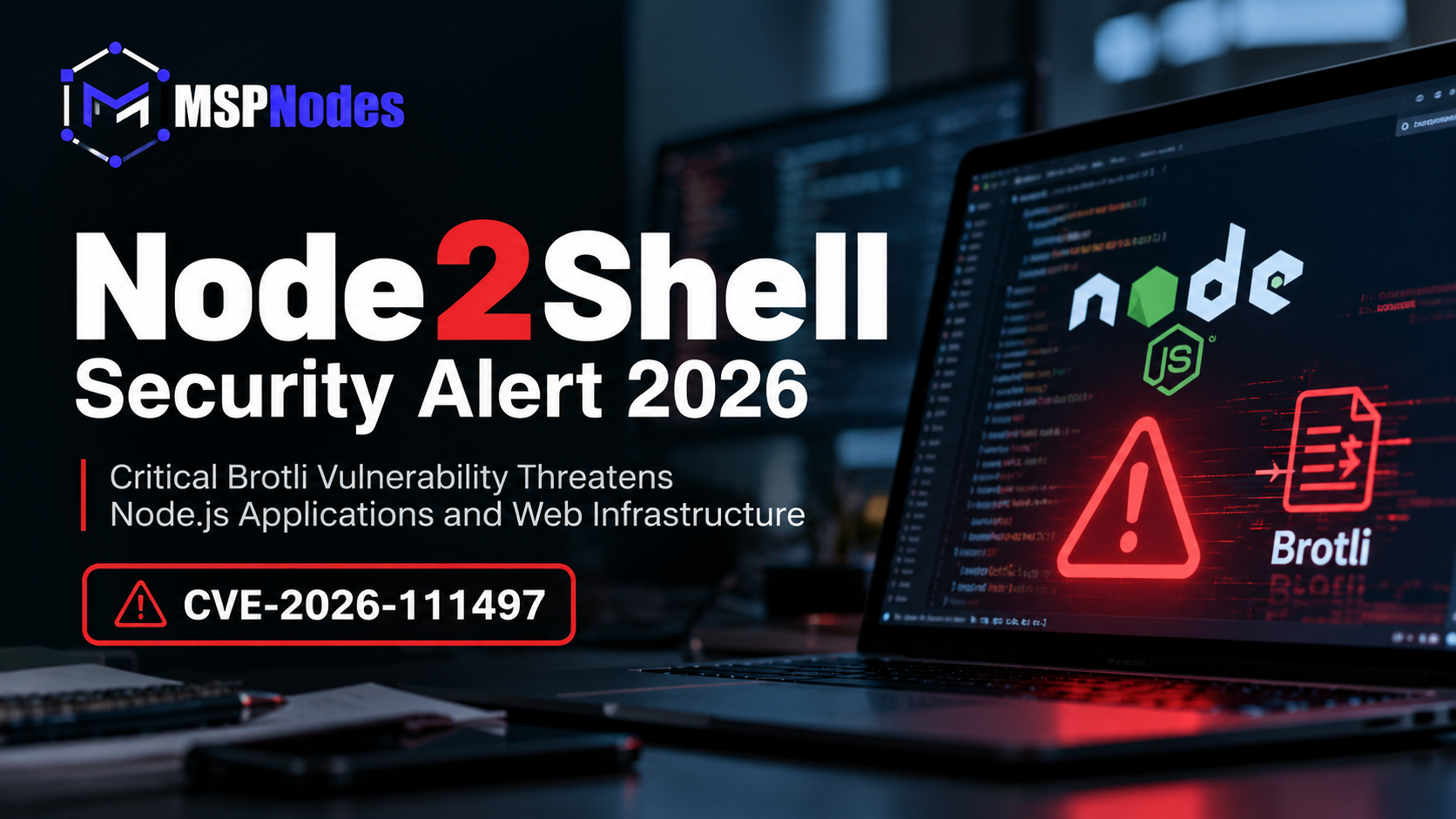
The vulnerability, tracked as CVE-2026-111497 and commonly known as Node2Shell or Broccoli2Shell, has a CVSS v4.0 severity score of 9.2 (Critical).
On October 27, 2026, the U.S. Cybersecurity and Infrastructure Security Agency (CISA) added it to the Known Exploited Vulnerabilities (KEV) Catalog following reports of active exploitation.
The concern is not limited to Node.js. Brotli is used across different software platforms, which means vulnerable versions of the library could be present in applications that businesses depend on every day.
For IT teams, the immediate task is to identify affected applications, check their dependencies, and apply the appropriate security updates.
What Is Node2Shell, and How Does It Work?
Node2Shell is an out-of-bounds write vulnerability affecting the Brotli decompression engine.
Brotli is a compression technology used to make web content smaller and faster to transfer. When an application receives Brotli-compressed data, the decoder processes it and reconstructs the original content.
The problem arises when vulnerable versions of the decoder process specially crafted compressed data.
Under certain conditions, the decoder may write information beyond the memory space allocated to it. This can corrupt application memory and potentially affect how the application behaves.
Depending on the application and its configuration, successful exploitation could lead to:
Unexpected application crashes or service outages.
Exposure of sensitive information held in process memory.
Corruption of application data.
Potential remote code execution (RCE).
There is an important distinction here: not every server running Node.js is automatically vulnerable to a remote attack.
For exploitation to occur, an attacker must be able to send malicious compressed data through an application path that uses the affected decoder.
This makes application configuration and exposure just as important as the installed software version.
Which Node.js Versions Need Updating?
The Node.js project released security updates on October 21, 2026, to address CVE-2026-111497.
The following releases contain the reported fixes:
Node.js BranchPatched VersionNode.js 22.x22.23.4Node.js 24.x24.22.1Node.js 26.x26.12.1
Organizations running earlier affected releases should review their environments and update to the appropriate patched version.
Unsupported Node.js versions also deserve attention. Where possible, these should be replaced with supported releases rather than maintained indefinitely.
However, updating Node.js alone may not resolve every instance of the vulnerability.
Brotli is also used in other software environments, including certain .NET applications, Python packages, reverse proxies, and third-party products.
Some applications include their own copies of libraries, while others depend on packages maintained by an operating system or software vendor.
Administrators should therefore check the relevant vendor security advisories and confirm which version of Brotli an application actually uses.

Why Should Businesses and MSPs Be Concerned?
One of the biggest challenges with Node2Shell is that the vulnerable component may not be immediately visible.
A business might have fully patched Windows or Linux servers while still running an application that contains an outdated software library.
The same problem can occur with cloud-hosted applications.
For example, a company running a Node.js application inside a Docker container may update the underlying server without updating the libraries packaged inside the container.
From an infrastructure monitoring perspective, the host may appear healthy and fully patched. However, the application itself could still contain the vulnerable component.
This is why Node2Shell deserves attention from both infrastructure engineers and application development teams.
If an affected application is exploitable, the potential impact may include service downtime, unauthorized code execution, sensitive data exposure, or disruption to customer-facing systems.
The severity of those consequences depends on the application, its permissions, and the surrounding security controls.
For MSPs supporting multiple customer environments, identifying affected applications can be more challenging than applying the patch itself.
Without accurate software inventories or dependency information, determining which systems require attention can take considerable time.
How to Protect Your Applications from Node2Shell
Organizations should approach Node2Shell remediation as part of their existing vulnerability management process.
The following steps provide a practical starting point.
1. Identify Applications Using Brotli
Review web applications, APIs, application servers, containers, and third-party products that use Node.js or Brotli decompression.
Pay particular attention to public-facing applications and systems processing externally supplied compressed data.
2. Check Runtime and Library Versions
Verify the installed Node.js version and identify any bundled Brotli dependencies.
For containerized workloads, inspect the application image rather than relying only on the host operating system's patch status.
3. Apply the Required Security Updates
Upgrade affected Node.js installations to the appropriate patched release.
For other applications using vulnerable Brotli libraries, follow the relevant vendor's security guidance.
Applications containing bundled or statically linked libraries may need to be rebuilt and redeployed.
4. Prioritize Exposed Applications
Focus first on applications that accept or decompress untrusted Brotli-compressed content.
Consider internet exposure, business criticality, application permissions, and existing security controls when deciding remediation priorities.
5. Review Logs and Security Monitoring
Check application logs, operating system events, and security alerts for unexpected crashes, unusual requests, or suspicious process activity.
Where there are signs of compromise, investigate according to established incident response procedures.
6. Test Applications After Patching
Once security updates are installed, verify that affected applications continue to work correctly.
Test API connectivity, authentication, application integrations, and other business-critical functions.
For Docker and Kubernetes environments, confirm that updated container images have actually been deployed.
What If Immediate Patching Is Not Possible?
If an application cannot be updated immediately, temporarily restricting its ability to process untrusted Brotli-compressed content may help reduce exposure.
However, such changes should be assessed carefully because they can affect legitimate application functionality.
Firewalls and Web Application Firewalls may provide additional protection, but they cannot guarantee that an application-level memory vulnerability will be blocked.
Installing the appropriate vendor-supported security update remains the preferred remediation.

What Node2Shell Means for Managed Service Providers
For MSPs, the Node2Shell incident highlights a familiar problem: keeping the operating system patched does not necessarily mean the entire application environment is secure.
Modern business applications rely on numerous software components, many of which are maintained independently of the underlying server.
A vulnerability in one widely used library can affect applications across different platforms, even when the hosting infrastructure is otherwise well maintained.
This makes accurate asset inventories, application dependency tracking, and clear remediation responsibilities particularly important.
MSPs need to know which customers may be affected, which systems require updates, and whether the necessary patches have been successfully deployed.
Coordination with application owners and development teams is often essential, especially when vulnerable libraries are bundled inside custom applications or container images.
Node2Shell is another reminder that effective cybersecurity requires visibility beyond servers, firewalls, and endpoint protection tools.
Final Thoughts
Node2Shell is a good example of how a vulnerability in a relatively small software component can create security concerns across multiple technology platforms.
The immediate priority for businesses is to identify affected Brotli implementations, install the relevant security updates, and verify that applications continue to operate correctly.
For MSPs, the incident also reinforces the need for accurate documentation, dependency visibility, consistent patch management, and reliable security monitoring.
These practices help organizations respond faster when critical vulnerabilities are disclosed and reduce the likelihood of outdated components being overlooked.
At MSPNodes, we work with businesses and Managed Service Providers worldwide to support cybersecurity operations, Windows and Linux server management, cloud infrastructure, vulnerability remediation, and managed IT services.
Whether you're maintaining business-critical applications or managing infrastructure across multiple customer environments, having dependable engineering support can make security maintenance and incident response more manageable.
Need assistance with vulnerability management, server security, or cloud infrastructure?
Visit https://www.mspnodes.com to explore our services and discuss your requirements.
Official References
Node.js — October 2026 Security Releases
https://nodejs.org/en/blog/vulnerability/october-2026-security-releases
Canadian Centre for Cyber Security — CVE-2026-111497 Alert
NHS England — Node.js Security Updates
https://digital.nhs.uk/cyber-alerts/2026/cc-4881
Published by MSPNodes | Managed IT Services • Cybersecurity • Cloud Infrastructure • White-Label IT Support